Be yourself; Everyone else is already taken.
— Oscar Wilde.
This is the first post on my new blog. I’m just getting this new blog going, so stay tuned for more. Subscribe below to get notified when I post new updates.

Be yourself; Everyone else is already taken.
— Oscar Wilde.
This is the first post on my new blog. I’m just getting this new blog going, so stay tuned for more. Subscribe below to get notified when I post new updates.

Social media exists today as a form of communication. People can connect to others worldwide by platforms like Instagram, Twitter, Facebook, Snapchat, etc. It is a way to bring online interaction, post sharing, and networking into one place and make it available to everyone who has an internet connection.
I feel the video is a helpful, educational tool for parents. It shows parents and guardians the dangers of social media and it brings to light how their kids online activity may be potentially harmful to their wellbeing. The newscasters highlight specific apps that are not appropriate for child use and talk about the possibilities of lude content sharing and inappropriate online behavior. As technology becomes more common and the average age of children who own technology becomes younger and younger, I feel videos like these are vital to educating parents. According to statistics published by some of the most well-known social networking services, there are more than 500 million active users on Facebook1, 175 million registered users on Twitter2, more than 100 million users on MySpace3, and more than 80 million members on LinkedIn4. Oftentimes parents give their kids phones and devices expecting them to be safe and not necessarily monitoring their activity. In reality, the online world is not a safe space for children. There are a lot of adults online who can present as people other than themselves or be anonymous. Moreover, there is a lot of inappropriate content on the internet that most parents would deem not suitable for children. It is the responsibility to montiner and decide what they feel is appropriate for their children. I feel that parents should be more involved just because it is very dangerous for young kids.
I have social media that I am active on. The apps I use are often to connect with friends and family, share photos that I take, and share content that I find interesting. I share hobbies that I enjoy, for example, photography. I do not feel social media is as dangerous to me, as an adult, because I can understand what social media seems dangerous and dictate for myself what I should and should not do online.
One of the most gruesome and sad social media stories I have heard was about Bianca Devins. She was a 17-year-old girl who had a following on the internet. According to an article written by The Cut, she frequented apps like Tik Tok and Discord. While online, she met a boy named Brandon Clarke. They were dating online and eventually met up in person. Clarke ended up killing Devins, recording and photographing it and posting the content online. The whole story is very sad and troubling and begs the question of where was her supervision. It is upsetting that she was able to talk to grown men on the internet and her life was taken from her at such a young age.
Kietzmann, Jan H.; Kristopher Hermkens (2011). “Social media? Get serious! Understanding the functional building blocks of social media”. Business Horizons(Submitted manuscript). 54 (3): 241–251.
“News Use Across Social Media Platforms 2018 | Pew Research Center”. September 10, 2018. Retrieved 2018-12-08.
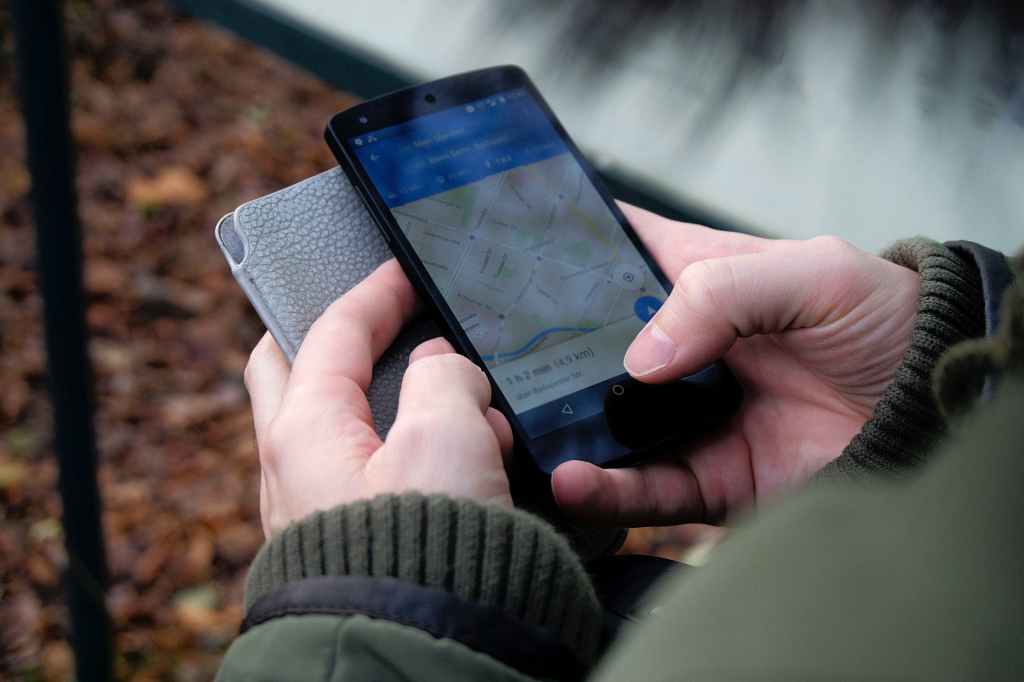
Privacy management is understanding the internet’s ability to spread and exploit personal information and applying this knowledge to an individual’s own internet experience and behavior. According to the website, this is defined as “The ability to handle with discretion all personal information shared online to protect one’s and others’ privacy.”
Being proficient at privacy management means understanding an individual’s right to privacy and keeping your own private information secured. Knowing that you do have a digital footprint and taking steps to manage this to contribute to a positive online presence. This includes working on what information an individual chooses to share on the internet and what safety precautions are taken. Further, privacy management is recognizing and respecting others right to privacy.
The threat of oversharing on the internet ranges from the person’s own reputation to businesses acquiring as much personal information as possible for their own corporate benefit. To provide an example, information that is made public online can be sold to third party buyers that utilize it for tailored advertising campaigns, products, and services. An internet user’s behavior, posts, and online preferences are continuously tracked by companies who want to use this relevant information. Without privacy management, internet users online information can be exploited.
Privacy itself is a fundamental human right as determined by the UN Declaration of Human Rights. According to privacyinternational.org, “Privacy enables us to create barriers and manage boundaries to protect ourselves from unwarranted interference in our lives, which allows us to negotiate who we are and how we want to interact with the world around us. Privacy helps us establish boundaries to limit who has access to our bodies, places, and things, as well as our communications and our information.” This all applies within the internet as well, however, the privacy laws in place are not up to date with the 21st century and internet. The laws get muddied as the lines between what information is considered private or what is not is challenged. This is why privacy management is so valuable. It is up to the individual user to mandate their own internet privacy and exercise privacy management to safely exist on the internet
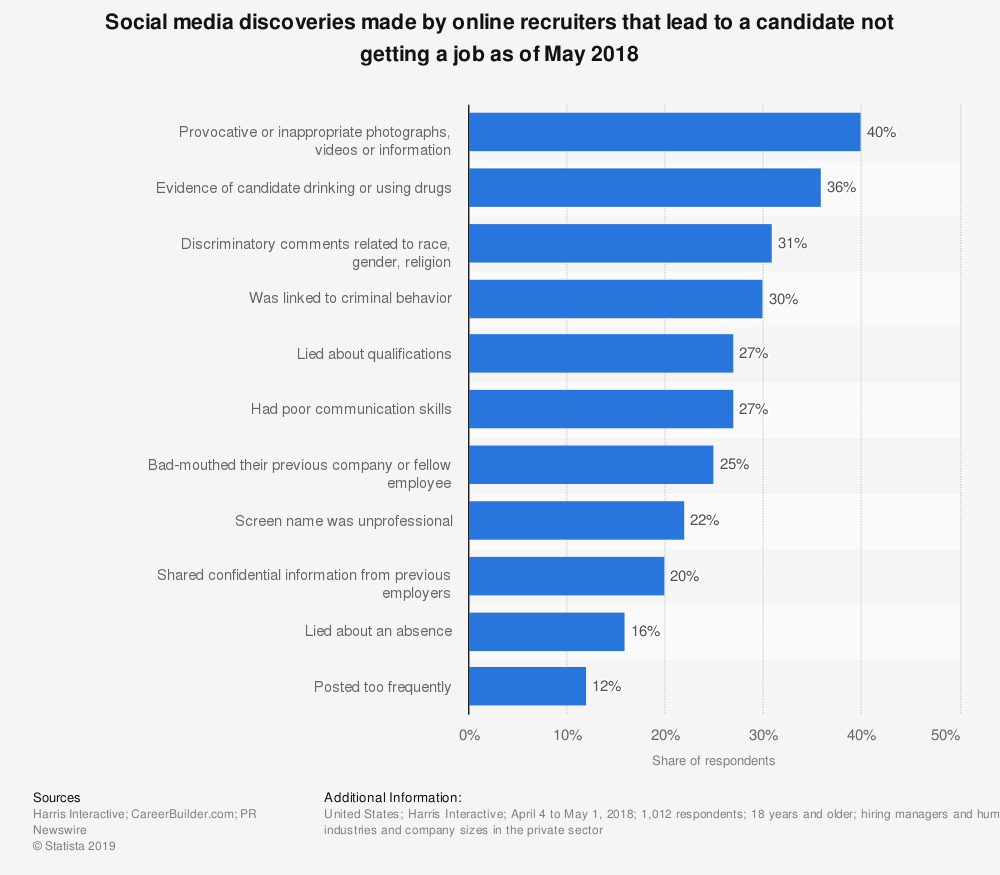
As shown in the graph above, ones internet presence is often a factor in job recruitment. Recognizing this fact and acting accordingly is a part of effectively exercising privacy management. Because jobs and companies have access to personal information that was posted online, internet users should post keeping this in mind and being consious of their internet presence.
The threat of oversharing on the internet ranges from the person’s own reputation to businesses acquiring as much personal information as possible for their own corporate benefit. To provide an example, information that is made public online can be sold to third party buyers that utilize it for tailored advertising campaigns, products, and services. An internet user’s behavior, posts, and online preferences are continuously tracked by companies who want to use this relevant information. Without privacy management, internet users online information can be exploited.
Privacy itself is a fundamental human right as determined by the UN Declaration of Human Rights. According to privacyinternational.org, “Privacy enables us to create barriers and manage boundaries to protect ourselves from unwarranted interference in our lives, which allows us to negotiate who we are and how we want to interact with the world around us. Privacy helps us establish boundaries to limit who has access to our bodies, places, and things, as well as our communications and our information.” (What is Privacy?) This all applies within the internet as well, however, the privacy laws in place are not up to date with the 21st century and internet. The laws get muddied as the lines between what information is considered private or what is not is challenged. This is why privacy management is so valuable. It is up to the individual user to mandate their own internet privacy and exercise privacy management to safely exist on the internet.
This is important to a Wai’anae Moku student because, as a college student who uses the internet, you are vulnerable to people access to your information and interpreting you online presence. There is a lot people can do with your information from the internet, it is better to stay safe and protected.
What Is Privacy? (2017, October 23). Retrieved from https://privacyinternational.org/explainer/56/what-privacy
Valentino-DeVries, Jennifer; Singer, Natasha; Keller, Michael H.; Krolik, Aaron (2018-12-10). “Your Apps Know Where You Were Last Night, and They’re Not Keeping It Secret”. The New York Times. ISSN 0362-4331.
Dinev, T., and Hart, P. Internet privacy concerns and their antecedents– Measurement validity and a regression model. Behavior and Information Technology, 23, 6 (2004), 413-423. [Google Scholar]

How has AI evolved over the past 70 years? (specify AI technologies)
Artificial Intellegence has come far since the 1950s. The technology originally was made with the intention to mirror basic human reasoning using problem solving and symbolic methods. Today, artifical intelligence stays true to these concepts and is far more advance and common in our everyday life. It is integrated into a lot of our workforce. In industries like healthcare, manufacturing, banking, and retail, AI technology is common and necessary.
– What did you learn from the 3 industry videos?
> How has AI changed the industry?
The integration of AI into most industries helps with efficiency. Whether it be work efficency or cost efficiency, the workforce is incorporating robots into positions that normally could have been occupied by humans. As seen in the videos, AI is able to fill roles that may have a shortage of workers. This being the truck driver industry. Autonomous truck driving is compensating for the lack of truck drivers in recent years, all while bringing down the cost of shipping goods. In the ‘Future of Farming’ video, there is new technology that allows the proccess of food collecting on the farm to be quicker, almost 2x faster than a human worker. In other videos, hotels are able to expand further using AI staff. Almost the entire proccess of checking into the hotels was by artifical intellegence, from the check in desk, to bringing the bag to the room, to turning off the lights.
> What issues has AI created for the worker?
In some instances, AI technology is more efficent at certain jobs than the human counterpart. We see in the videos, robots occupying jobs that originally where assigned to humans. It is explained in ‘Inside the Japanese Hotel Staffed by Robots’, that this is not only a fun new way to have hotels run, but also means to make more profit. To quote, “As a consumer, we’re going to forced to love robots. They’re going to be packaged up as dinosaurs but for the people driving this innovation, it’s really capital thats doing that.” (11:00.) However, there is still a need for human workers, as the hotel manager, Akikazu Fukumoto pointed out in ‘Inside the Japanese Hotel Staffed by Robots’, “You have to respond to the needs and thoughts of the customer, so the spirit of hospitality still requries human interaction” (3:00) As Mr. Fukumoto is trying to say, there is some jobs and services that AI, as they are developed today, can not provide.
– What will be AI’s impact on society in 2030? (Provide your personal opinions)
> Our personal life
Our personal lives will likely become a lot more simplified and efficent with the help of AI. Just as how the internet and technology became integral parts of our lives, I feel artifical intellegence will do the same. For example, our homes become smart houses will change how we live and exists in our own homes. The services and companies we buy from will be using AI technology, so we will be benifitting from that as customers.
> Our interactions
The way we interact with others may change as there will surely be less of it in the future. Things like customer service is already almost all automated today when you call in with issues about a product. Further into the future, there will be less of a need to interact with others out of necessity.
> Your professional career
AI poses a threat to a lot of the worlds job security and I feel this is a really big problem that not a lot of people are addressing. Ulitmately capitalism relies on making the most amount of money while having the least amount of expenses. If humans become unnessisary expenses, most companies will opt for the more cost effective option, that being artifical intellegence.
> What types of technologies/services do you envision seeing related to AI?
I envision the medical field and manufacturing field being for the most part being occupied by Artifical Intellegence. I would hope AI will be incorperated more into space exploration because it would be very useful in this realm.
1) What digital footprints are
Digital footprints are defined as traceable data that is left behind by internet users. According to the video, ‘Four Reasons to Care About Your Digital Footprint’, “When we visit websites to get information, do social sharing, send instant messages and email, we leave something behind. Our digital footprints are the traces we leave behind as we use the internet.” It is a permanent data trail that is tracked, analyzed, and often used to make a profile of the user.
2) How digital footprints are created
Digital footprints are created when internet users leave data behind while browsing/using the internet. Everything that is posted to the internet has the potential to exist there forever, it is difficult to erase things completely off the internet. Websites, social medias, apps, banks, ect. keep tabs on their customers and site visitors.
3) How are our digital footprints used by corporations
Corporations can utilize digital footprints to monetize.The information that is tracked online is often sold to third party companies which allows these companies to predict the online users personality, race, age, and overall life. Companies are capable of building a profile of all internet users with digital footprints, and with this comes targeted ads. To better get their advertisement to the audience, the companies use a method of target advertisement. Target advertising is when you see a certain ad depending on your demographics: where you live, your age, your gender, your likes, your dislikes. Targeted advertisements can show users products they have been recently reading about or looking at online, but even more problematically, advertisers can predict what items users would buy based on their profile and demographics.
4) Things people do to create negative digital footprints (include consequences)
Negative digital footprints are often created with social media. When posting on social media, data and sometimes negative information accumulates and this can be found very easily. Employers often conduct background searches of potential employees, focusing on their digital footprint. As seen in the ‘Attention young professionals! What’s in your digital baggage?’ video, a lot of this data is simply accessed through Google. According to The Pew Research Center, “The majority of online adults (61%) do not feel compelled to limit the amount of information that can be found about them online. Just 38% say they have taken steps to limit the amount of online information that is available about them.” With such a large percentage of online users posting so carelessly, it is negatively affecting their job opportunities.
5) Strategies for creating positive digital footprints. Find a video (on YouTube) or a webpage (on Google).
To create a positive digital footprint, users should be conscious of what they are putting online and posting accordingly. The first step to having a positive digital footprint would be understanding what a digital footprint is, and knowing that things are tracked on the internet. Knowing this, users can take precautions when on websites and social media. Being aware of what websites you visit and being purposeful about what you choose to reveal on social media would be beneficial towards creating a positive footprint.
References
[AVG Technologies]. (2012, October 23). Attention young professionals! Whatʻs in your digital baggage? [Video File]. Retrieved from https://youtu.be/zlM-YuUQ3Ms
[Global News]. (2018, June 23). How facebook creates a profile from your data to sell to advertisers [Video File]. Retrieved from https://youtu.be/Azr41OUTOt8
[Internet Society]. (2016, January 12). Four reasons to care about your digital footprint [Video File]. Retrieved from https://youtu.be/Ro_LlRg8rGg
Madden, Fox, Smith & Vitak, Mary, Susannah, Aaron, Jessica (2007). “Digital Footprints”. Pew Research Center.
Pew Research. (2013, October 1). Why youʻre still bored. Retrieved from https://laulima.hawaii.edu/access/content/group/LEE.56067.202030/Images/oversharingstats.jpg
[Positive Coaching Alliance]. (2015, April 9). Social media: donʻt lose a $140k scholarship for a 140-character tweet [Video File]. Retrieved from https://youtu.be/MgB8xBJaBoU

This is an example post, originally published as part of Blogging University. Enroll in one of our ten programs, and start your blog right.
You’re going to publish a post today. Don’t worry about how your blog looks. Don’t worry if you haven’t given it a name yet, or you’re feeling overwhelmed. Just click the “New Post” button, and tell us why you’re here.
Why do this?
The post can be short or long, a personal intro to your life or a bloggy mission statement, a manifesto for the future or a simple outline of your the types of things you hope to publish.
To help you get started, here are a few questions:
You’re not locked into any of this; one of the wonderful things about blogs is how they constantly evolve as we learn, grow, and interact with one another — but it’s good to know where and why you started, and articulating your goals may just give you a few other post ideas.
Can’t think how to get started? Just write the first thing that pops into your head. Anne Lamott, author of a book on writing we love, says that you need to give yourself permission to write a “crappy first draft”. Anne makes a great point — just start writing, and worry about editing it later.
When you’re ready to publish, give your post three to five tags that describe your blog’s focus — writing, photography, fiction, parenting, food, cars, movies, sports, whatever. These tags will help others who care about your topics find you in the Reader. Make sure one of the tags is “zerotohero,” so other new bloggers can find you, too.
 Deana Goslin's Blog